Tuesday, October 30, 2012

Honda Dream Yuga review

Honda is gunning for the Splendor and Passion combo with the Dream Yuga. But, is the new contender up for the task? AUTO BILD INDIA rode it to find out

It’s a tough ask, but Honda believes it must be done. Not that the other bike makers haven’t tried; in fact, they have tried nearly everything from offering more powerful and better equipped options at lower prices to alternatives that sport radical technologies. But, Hero’s Splendor and Passion combo continue to reign supreme, and are the default choice for entry-level bike buyers even years after their debut.
So what has Honda done to take on the might of the Hero duo? It has gone ahead and roped in Bollywood star Akshay Kumar and then followed it up with a generic, almost boring looking 110cc bike. The bike might have an attention grabbing name – Dream Yuga – but it looks quite ordinary and one can easily confuse it with Honda’s own Shine.
So, not the best step forward then? Actually, it is. You see, because it is so generic, the Dream won’t polarise opinion. And when you are looking at huge sales numbers to come from all across the country, you’d rather have a simple and palatable dish. Nonetheless, it is very well put together. The quality of the plastics and the paint is class leading. The finish too - be it for the engine or the chain-guard or even the levers – is right up there with the best in the segment.
Moreover, the moment you sit on the bike, the seat’s width and firmness as well as the feel of the handlebar grips feel just right and the ergonomics is spot on too. The distance and the height of the handlebar and the positioning of the pegs feel natural and comfortable instantly. Plus, the ergo makes the bike feel compact (not puny, mind), and therefore, easier to manoeuvre.
And easy to ride in traffic, particularly at slow speeds, the Dream certainly is. It feels light and flickable and the effort required to get it to change directions is almost zilch. Additionally, it has light and progressive controls which holds true for the clutch as well as the throttle. The brakes of course are drums at both ends, and the brake feel and bite are quite poor.
What’s endearing about the Dream though, is its performance. There’s clearly no purchase at the top end and hitting 90kmph is an achievement. However, in the low and mid range, its performance does get your attention. It feels perky, like a small dog, ready to jump and get going every time you let the clutch out from a standstill. The enthusiasm stays till about 80kmph beyond which the performance tapers perceptibly and vibes begin to surface. The 4-speed gearbox though works well; the shifts are positive and short, and it doesn’t require much effort to click into place either.
Clearly Honda has taken a straight forward approach with the Dream. It hasn’t gone ahead and tried to reinvent the wheel like many other bike makers in the entry-level segment, instead it has gone ahead and bettered the design. The Dream for its segment is outstanding. It doesn’t offer more quantitatively, but qualitatively, it redefines the segment. Be it ergonomics, quality, the riding experience or even the outright performance and manoeuvrability, it just sets new benchmarks for the segment. But then, to take on the Splendor and the Passion, nothing less would have done.

Courtesy: www.autobild.in

Bajaj Pulsar 200NS review


The new Pulsar has been unveiled and AUTO BILD INDIA has ridden it. And to say it is a big improvement over the older Pulsars would be an understatement, for this one, the Pulsar 200NS is leagues ahead

The Pulsar is a legend. It has changed the landscape of motorcycling in the country, particularly one that caters to the enthusiast like no other. Not only did it set the stunt scenario in the country rolling, it also introduced a number of firsts; there was digital instrumentation, backlit switchgear and of course the concept of proper muscular styling. No wonder it still is the motorcycle to beat when it comes to sales in this segment.
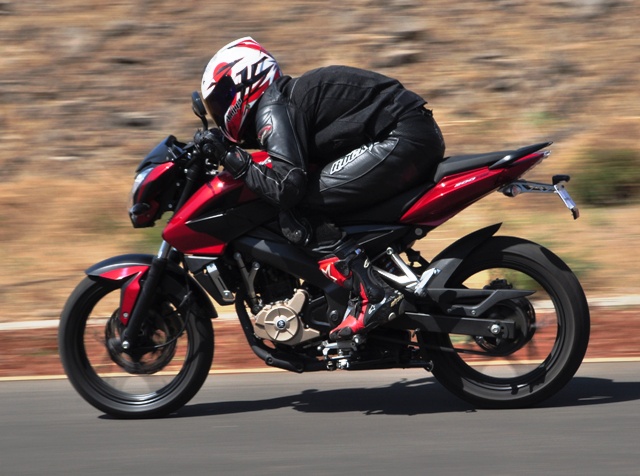
Clearly, following up this act had to be an uphill task from the word go. The good news is Bajaj has pulled it off, and how. The new Pulsar, the 200NS, is an outstanding bike. And not just in the way it looks; though, we’d say it’s a head-turner for sure. Today when most bike makers have chosen the fully faired route for their Indian made high-end bikes, Bajaj has gone in for a street fighter outlook. It’s also retained its muscular look; from the headlamp to the tank and its extensions and even the size of its tyres, the Pulsar 200NS is absolute brawn.


Thankfully when you begin riding it, the NS is less like a gym boy and more like a boxer. It’s very light on its feet. Now we did only ride the NS at the Bajaj’s test track, but it’s quite a challenging one for the bikes – there are tight S bends, flat out long radii corners and a straight long enough to max out the bikes; at least we did manage to max out the NS and it indicated a top speed of 141kmph.
As for its cornering abilities, like we said it’s very nimble on its feet. There’s no real effort required to get it to turn in whether it’s a series of quick direction changes or correcting your line mid corner around a fast bend. All it needs is a slight push of the handlebar and it ends up pointing in the direction you want it to go with the least bit of effort. The excess wallowing that plagued the previous Pulsars has been eliminated as well; no surprise it gives the rider a lot more confidence now.
Just to give you a better idea, the NS feels easier to corner with than say a CBR 250R and dare we say it - almost as flick-able as the R15! However, compared to the above mentioned motorcycles, the NS lacks feedback which is mainly down to its tyres. It also lacks the planted feel of the R15 around a bend. Not that there’s anything wrong with the cycle parts of the new Pulsar. It does get a hybrid twin spar frame made of pressed steel, meaty front forks, a monoshock with a box section swingarm at the rear and reasonably fat tyres. But it just lacks that connect than the R15 is able to deliver.
We were quite impressed with the NS’s engine as well. It is heavily based on the KTM Duke 200’s engine with the lower half of the engine being almost identical. It also displaces the exact same capacity, is liquid cooled and also has a hugely oversquare layout to keep its fast revving nature. Here too the engine is coupled to a six-speed gearbox.  However, Bajaj has made changes to the head. So, besides running a single overhead cam against a DOHC setup on the Duke, the NS also gets three spark plugs against just a single one on the KTM.
The end result is lesser power and torque compared to the KTM and with it a slower acceleration time as well. Undoubtedly, apart from the three spark plugs all other changes have been carried out to reduce costs compared to the Duke including use of a carburettor instead of fuel injection on the KTM. Also Bajaj wants the 200NS to have a respectable fuel economy which will go along with its pricing of under a lakh of rupees.
In terms of feel, the engine is an easy revving one and even at the redline, it doesn’t sound too strained or coarse. It has good drive in the mid range too which makes corner exits quite enjoyable. The throttle response again is sharp and there’s no snatchiness to the drivetrain at all. The gearbox though could be better. It’s not as positive or well weighted as the competition and it threw up some false neutrals on our as well.
We are also not very happy with the finish at some places. The switchgear for instance looks a tad tacky and so do the fuel cock and the plastic surrounding the rear seat lock opener. Then there’s the gap between the tail piece and the rear seat itself which clearly hints towards finish issues. In terms of finish we would have like the footpeg hangers to be better finished as well.
As we mentioned right at the start, the Pulsar 200NS is way better than the Pulsars of yore. But, this is not where it ends. It’s also right up there with the best in the segment. It has the looks, the features and even comfortable ergonomics. Yes, it might not be as fast or as well finished as most others in the segment, but in terms of riding fun, dynamic prowess and even performance, it’s a bike you can consider without giving a second thought. Especially, if it’s going to be priced at about Rs 90,000.

Specs

Bajaj Pulsar 200NS

Engine single cyl, liquid cooled
Displacement 199.5cc
Max power 23.5bhp@9500rpm
Max torque 18Nm@8000rpm
Gearbox 6-speed
Wheelbase (mm) 1363
LxWxH (mm) 2017x1195x804
Kerb weight 145kg
Fuel tank 12.0 litres

Courtesy: www.autobild.in

Monday, October 29, 2012

Honda CBR 150R review


It might be smaller and less powerful than the CBR 250R, but is it also less fun to ride? We spend extensive hours riding the new CBR 150R to find out

It might be the smaller of the two in size, engine capacity, price and positioning, but one thing is for sure - it certainly has a better exhaust note, particularly at idle. We are talking about the new Honda CBR 150R, and of course being compared with it, is the older, bigger, more powerful and expensive -  CBR 250R. In terms of looks though, these are almost identical.
However, the 150R isn’t here as an alternative to the latter at a lesser price; it is here specifically to take on the Yamaha R15 and the more recent KTM Duke 200. Being a clone of the bigger CBR, it does tick the right boxes in terms of visual appeal, so much so that its full fairing, chunky tyres and overall mass lead you to believe this one must displace more cc-s than just 150.
Once you mount the motorcycle though, it’s instantly clear that the 150R is smaller and narrower than the 250R in dimensions, but still larger than say the Duke. The look and feel though is identical to the larger CBR – the clocks, the tank shape and even the riding position is similar. The quality though is surely better on the 150, even though we were disappointed by the switchgear which is more like what you get on cheaper, more commuter-centric Honda bikes.
To really appreciate the 150R, however, one must ride it. Its seating ergonomics is less demanding to start with; it’s still sporty, but one sits more upright asking less from the back and the rearsets positioning don’t threaten to tear your calf muscles either. Moreover, the seats aren’t overtly hard and the handlebar is anything but a stretch to reach; if at all, it’s just a tad narrow.
What we would have liked though, is a more refined engine. This single cylinder, liquid cooled and fuel injected engine starts off well from idle but the moment it hits the 6,000rpm mark, vibrations begin to creep in. The harder you push from then on, the coarser the engine sounds. It’s an engine that packs in all the fun right at the top of the rpm band, but it lacks that free-revving nature that makes you want to exploit this high-strung characteristic of the engine.
There’s however a clear step-up in performance past the 8,000rpm mark and the pull continues till the engine hits its redline at 11,500rpm, but to enjoy this performance you must tell yourself that it’s ok to wring the life off this engine even though it’s not too willing. The shift quality of the 6-speed gearbox doesn’t impress much either; it’s not slick, doesn’t have well-weighted shifts and is notchy. Moreover, it can leave you hanging without a drive at the most crucial time.
The 150R’s forte though is its dynamics and it’s surprising given our experience with the 250R. The latter is, after all, the mushiest 250cc on sale in India. The younger CBR though is exceedingly good. It’s light, precise and extremely communicative. You can place the 150R in a corner where you want it, how you want it and when you want it. There’s so much feedback from the chassis and particularly from the tyres that you can carry a lot more speed around a bend without scaring yourself or even noticing it, for that matter. The braking too is outstanding – there’s less bite initially, but when it comes in, it comes it hard and with so much feel and linear progression, you get on the brakes hard and hold it knowing exactly what the front tyre is doing.
Ideally, I would have loved the combination of the 150R’s dynamic ability married to the performance prowess of the 250R’s engine. Sadly that’s not going to happen in a hurry. But, even with the 150cc powerplant, the 150R is a joy to ride especially if you love tackling corners; you’d always come out the other side with a wide, satisfied grin. What’s more, in the orange and white paint scheme, it looks good too and draws a lot of eyeballs on the roads. Wish it were priced a tad lower though.

Courtesy: www.autobild.in

Hero Maestro Review


A scooter for males? Is there more to this than just a marketing spin? We rode it to find out

The Maestro, says Hero, is a scooter meant for males. So, compared to its only other scooter offering, the Pleasure, the Maestro is bigger, brawnier and surprisingly more stylised as well. And by stylised we don’t mean it’s heavily plastered with stickers; in fact it has none. But, the shape of the headlamp, the front apron and the rear, not to mention the slanting floorboard, make it look very up-to-date. We also found the carbon fibre like finish of the seat cover a nice touch.
The Maestro also feels big once you get astride. The floorboard is large and there’s good distance between the seat and the handlebar enhancing the feel of roominess. The clocks look great and are easy to read too, and the quality, then be for the paint or the plastics or even the fit and finish is right up there with the best in the segment.
Now, the Maestro might be the second product from Hero after its split with Honda, but underneath that stylish shell, it still runs Honda hardware. So, the 109cc engine is the same reliable and refined unit used on the Activa. The CVT transmission too is the same. And one can feel it the moment you open the throttle. There’s no shudder at start up, the pick-up is smooth and linear, and the engine runs with the serenity of a monk no matter how hard you rev it.
The Maestro shares its underpinnings with the Activa as well and runs the tried and tested tubular underbone chassis suspended on segment standard trailing link setup at the front and a unit swingarm at the rear. However, the Maestro does run a mildly longer wheelbase. As far as ride and straight line stability goes, the Maestro is absolutely par for the course. The ride is supple for most part and it manages quick direction changes well too. And we like the fact that this Hero also comes with Combined Braking as standard.
If you like the Activa, you will like the Maestro, no question. Only the Maestro looks more modern and has some nice bits like fancier clocks and sturdy looking folding pillion footrests. It’s priced well too at Rs 52,000 on the road in Delhi, especially when you consider that a large glovebox, Combined Braking and a side stand are standard at this price. As far as it being a scooter for males, all we can say is, males certainly look better riding it than they do riding the Pleasure.

Courtesy: www.autobild.in

Bajaj Discover 125ST Review


As if Bajaj did not have enough Discovers in the market already, it has introduced yet another version. This one is called the 125ST and promises to be more than just a daily commuter

The trick to managing higher sales it seems is to have numerous models catering to a single segment. And Bajaj certainly wants more numbers, if for nothing else, but to get back its number two spot from Honda. A great learning on how to get the most from this trick comes from Maruti Suzuki. Not getting into the specifics, it has almost 10 models (not including variants) in what we would traditionally describe as the small car sphere. And this segment alone is responsible for Maruti's number one position.


Now Bajaj wants to do the same in the commuter motorcycle segment. But unlike the carmaker, it will do so with just two brands - Platina and Discover - but with multiple variants for each. Take the Discover for instance; there are already four versions of it on sale. There's the 100 with a four-speed and five-speed gearbox option, there is the 150 and in between, there's the 125. And now there's another new version called the Discover 125ST.
The ST is essentially the Discover 125, albeit with new clothes and some heavy technical modifications in both engine and chassis departments. The styling is more grown up and modern compared to the existing Discover line-up as well. It also looks more imposing and muscular, even though it is smaller than the current range in all dimensions barring the wheelbase, which is identical to the current bike. It does however get a bigger fuel tank and a wider tailpiece. The overall width though is narrower courtesy the reduced width of the handlebar.

It’s also easier to mount thanks to a lower seat height, and the seat itself, is more comfortable now. Plus with a larger tank the feeling of sitting 'in' the bike is more pronounced. Overall ergonomics though are still very commuter like and work well while tackling city traffic. It also has light controls; the clutch is effortless to pull in and changing gear requires no real force.  It also feels very light on the move feeling nimble and less tedious to ride around in the city.
The ST uses the same chassis as the current Discover 125, but now sports a monoshock at the rear making the ST the first bike in the segment to get one. The setup not only helps the new Discover ride well over almost any surface, it also ensures the 125cc Bajaj doesn't feel completely out of sorts with a pillion on board. Moreover, at whatever pace it can manage, it handles the corners decently well too. The only limiting factor here are the tyres.
The engine too is the same as the Discover 125 including the bore and stroke, but the head design is different. The ST sports 4-valves for better breathing at higher revs, much like the Pulsar 135LS. It also makes more power, but at higher revs compared to the standard 125 and exactly the same peak torque, albeit again at a higher rpm. On the road, the ST doesn't feel much quicker or more ride-able than the standard bike in the low and mid range, which is where most people would end up riding the machine.
However, towards the top end of the rpm spectrum, the ST feels a lot more alive than any other 125cc bike. It also sounds better when revved hard. In fact, it’s only when ridden hard that the ST felt special and brought a smile to our face. In commute mode though, it felt quite ordinary.
The Discover 125ST wants to be more than just a commuter; it wants to be a fun to ride bike, even on longer jaunts, while hoping to bring back youth into the commuting space. In terms of looks, slow-speed flickability and top end performance, it certainly catches the eye. And with some upmarket parts like a 4-valve head and a rear monoshock, it must certainly have the enthusiast’s attention as well. It is still an ordinary commuter though, but what remains to be seen now is how it is priced, and what real world fuel economy it manages to return.

Courtesy: www.Autobild.in

Royal Enfield Thunderbird 500 review


Royal Enfield says the new Thunderbird 500 is ideal for cruising down highways. We took a road trip to Ooty to find out if it really is the highway star, the company says it is

It might have been a cash-strapped company’s attempt to turn its fortunes around, but the Thunderbird today has a cult status. It is the bike of choice for many looking at touring on two wheels. However, it has gotten quite old in the tooth now, and its inherent shortcomings are becoming a tad too obvious; even to its die-hard fans.
To arrest this, Royal Enfield is now ready with a significantly updated version of the motorcycle. Called the Thunderbird 500, the bike gets all new styling and new-to-the-model engine and cycle parts.
The engine and gearbox is borrowed lock, stock and barrel from the Classic 500 with the gear ratios as well as the final drive having been left untouched. And, that's not a bad thing given the model gets a higher capacity, more powerful and modern engine compared to the older Thunderbird. As with the Classic, the new Thunderbird gets fuel injection along with tremendous portions of pull in the low and mid range. Whack open the throttle from as low as 2000rpm and the Thunderbird accelerates seamlessly and with gusto almost all the way to its 6000rpm redline.
It's also surprisingly quiet with the rider hearing the exhaust note above all else when on the move. The only issue here, in typical Bullet fashion, are the vibes that surface at 3000rpm but get really bothersome close to 5000rpm. These can be felt most via the fuel tank and the footpegs. The good bit though is, thanks to the gearing even when cruising close to 120kmph, the engine isn't revving this high. So, even after hours of riding there's no tingling sensation or scratching to be dealt with.
Moreover, the styling related changes work well too. The new motorcycle still has the characteristic Thunderbird stance with the round headlamp, high handlebar, the upswept tank and a stepped seat. The latter though is now a split design with the rear seat coming off for better luggage carrying capability. In addition, the headlamp is now projector type for better illumination, the fuel tank is larger for better range, and with the forward set footpegs, the seating ergonomics is more comfortable too.
But, the most outstanding bit about the new Thunderbird is the way it handles. It uses the same chassis as the Classic, but sports meatier front forks and a stiffer oval section swingarm. We rode the new Thunderbird up to Ooty from Bangalore and on the 50km odd, well-laid and seriously twisty ghat section, the bike surprised us with its willingness to turn into corners and make quick direction changes as well.
It feels light and neutral while tipping into bends and even when leaned over there's hardly any swaying or wallowing from the chassis; in fact given the weight and the size of the bike, it feels tight and confident while attacking corners. Thanks to repositioning of the front footpegs, the bike can be leaned more too before the footpeg scrapes around a left bend and the exhaust shield when leaned over to the right.
We aren't very happy with the bike's braking though. Sure, it does get a 280mm disc upfront and a 240mm disc at the rear wheel, but the feel from the brakes is wooden. Also the bite isn't great, so if you do get carried away and push a little harder, things can get hairy if you need to stop in a hurry. The MRFs though - the 90/90 19in at the front and the 120/80 18in at the rear offer decent grip, even in the wet.
If every new product launched by a company feels as if it is its best yet, the company is obviously doing something right. And Royal Enfield, in our opinion is now that company. It surprised us with the Desert Storm last year, and now with the new Thunderbird it has done even better. The bike not only has been finished with good attention to detail but it also sorts out problems Bullets were infamous for, particularly dynamics. It handles well, is ergonomically a lot sounder and with that torquey 499cc engine, the Thunderbird is also quick and well suited for highway cruising. It still is vibey and it could do with better braking, but there's no doubt that if you're looking at buying a Bullet for touring, or a Bullet, period, the Thunderbird 500, is clearly the one to go for.


Courtesy: www.autobild.in

Yamaha Ray Review

I am over 30, not all that pretty, and I, certainly don’t have a fetish for pink soft toys lining my bed. Clearly then, the scooter I am riding, isn’t targeted at me. It’s here to give 18-year-old pretty girls wings. Therefore, it’s light and has a low seat height, says its maker.
But, surprisingly, the Yamaha Ray doesn’t feel very girly to ride, or to look at for that matter, if one were to overlook the colour scheme. Actually, it’s a sharp looking scooter with youthfulness dripping from it. The front resembles the Honda Dio to a great degree, but that’s not such a bad thing. It’s also not small like the TVS Scooty; in fact, its length (1835mm) and wheelbase (1,270mm) are one of the longest among scooters in India, including some 125cc offerings.
The Ray, though, displaces 113cc. It's an undersquare engine coupled to a CVT and makes max power of just over 7bhp. The peak torque is rated at 8Nm and both these output figures are at par with other scooters in the category.
Once astride, the Ray’s narrow and low seating becomes obvious. So much so, that for my size it actually feels a bit cramped. The floor board is pretty narrow too. Get it off the stand and the Ray’s lack of weight becomes clear too. On the move, the Ray is tremendously flickable. One can drop it left or right with utmost ease and confidence which should make it a superb ride for filtering through traffic. The braking again impresses; the 130mm drums at both ends and the grippy tyres bite into the tarmac with ferocity. The only issue is the brake feel, which the optional front disc would easily take care of. 
As far as the powertrain goes, the 113cc engine is smooth and the CVT works without hassle. But, given the Ray’s light weight and 7bhp of max power, we expected the scooter to be peppier, at least the initial pickup. It’s not slow, but it can’t hold a
candle to the likes of the Suzuki Swish either.
At Rs 46,000, the Ray is priced well. It should appeal to young working women given how easy it’s to ride, thanks mainly to its light weight and narrow width. It’s also well put together, though the plastic bits in a few places could have been of better quality. The design is crisp and clean, but it isn’t a product that can be tagged as a game changer since it doesn’t bring anything new or outstanding.